Best Litter Mats (2026): Trapping vs Double-Layer vs Honeycomb
Updated 2026-10-16 · HappyPawPicks Editorial
HappyPawPicks is reader-supported. Some of our recommendations include affiliate links. If you buy through them, we may earn a commission — at no extra cost to you. As an Amazon Associate I earn from qualifying purchases. Our editorial process is independent and never influenced by commissions.
Start here: litter tracking is a coverage problem
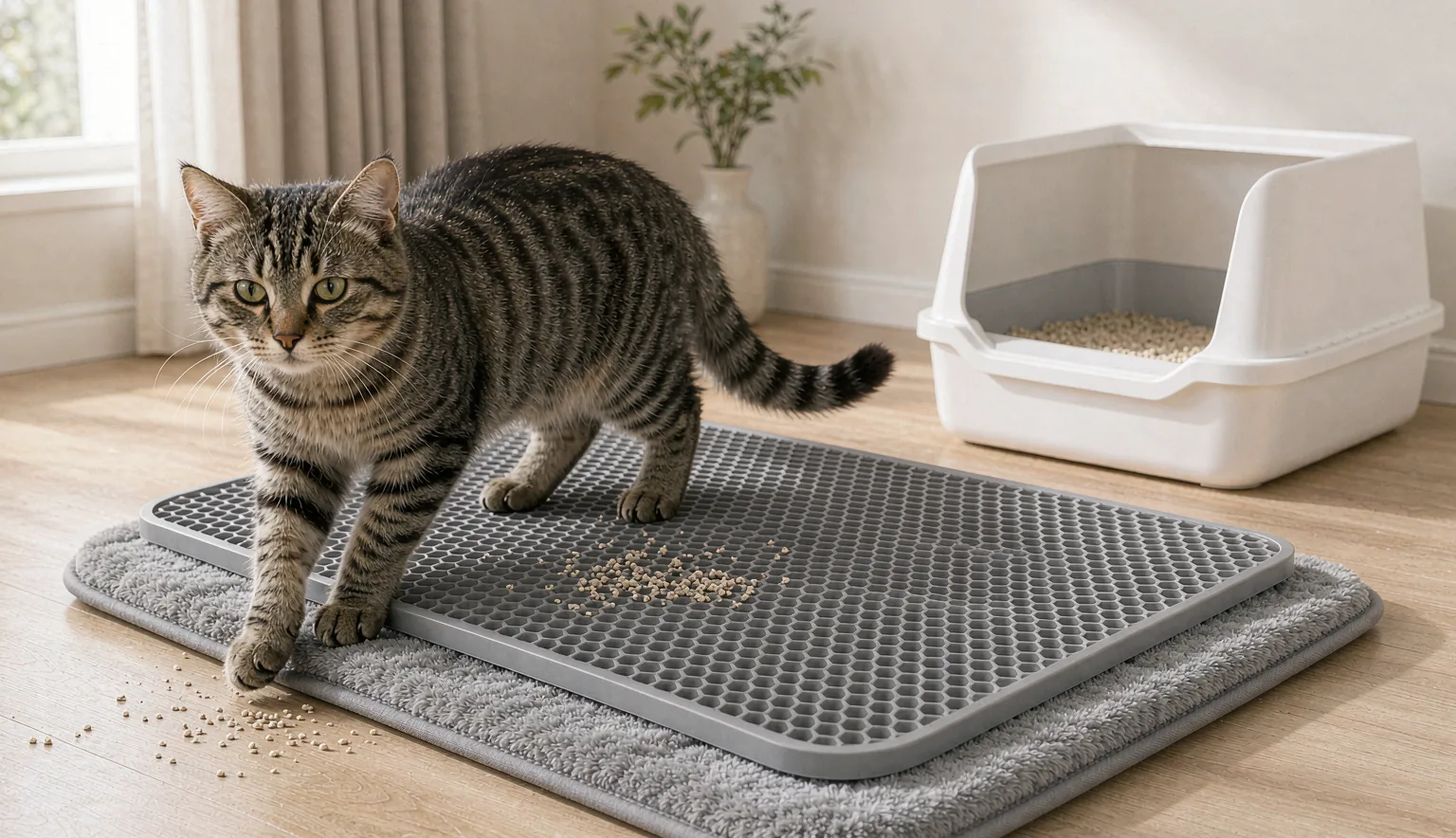
Litter on the bathroom floor is not really a litter problem or even a mat problem — it’s a geometry problem. A cat leaving the box carries granules wedged between its paw pads, and those paws stay loaded for three to five steps. Whatever surface covers those steps catches the litter; whatever sits outside that zone gets decorated. This is why the mat people call “the one that didn’t work” is almost always the right mat in the wrong size: a decorative 18-inch doormat under a big box catches the first step and misses the other four.
So the first decision is not brand or material — it’s how much floor you can cover. Size beats material every single time. A large mediocre mat outperforms a small excellent one, because a mat only works if the cat has to walk on it. The second decision is what happens to the litter after it’s caught: a mat that traps granules in a sealed layer empties in seconds, while a mat that holds litter on its surface means vacuuming forever.
Here’s the reassuring part: the entire category lives between roughly $12 and $35, and the differences that matter — layer design, surface texture, opening mechanism, size — are all things you can evaluate from the product page. Below is how the three real designs compare, and which fits which household.
How we picked
We focused on the designs that dominate the category and the specific models that consistently top best-seller lists in cat litter mats: the double-layer honeycomb mats (Pieviev, iPrimio, Powools, WePet), the coiled-mesh trapping mats (Gorilla Grip), the ridged carpet-over-tray design (BlackHole), and the absorbent fabric mats (Drymate). We judged each on the factors that change what your floor looks like a week later, not the ones that photograph well:
- Coverage — size relative to the exit path, since this is the single biggest lever on how much litter gets caught.
- Layer design — whether litter is trapped underfoot in a sealed pocket or sits on the surface waiting to be scattered.
- Paw acceptance — a mat the cat refuses is a $25 rug; soft EVA and fabric win here over stiff plastic.
- Emptying and cleaning — how many seconds the weekly routine takes, and whether deep cleaning is a hose-off or a hassle.
- True cost per month — cheap mats curl, flatten, and delaminate; the math is about replacement cycles, not sticker price.
Compared
| Mat | Design | Size | Typical price | Rating | Best for |
|---|---|---|---|---|---|
| Pieviev Cat Litter Mat | Double-layer honeycomb EVA | 30×24 in | ~$22–25 | 4.5 | Most homes; best all-round trapping |
| Gorilla Grip Litter Mat | Coiled-mesh trapping | 35×23 in | ~$20 | 4.4 | Large coverage; clay litter; hose-off cleaning |
| iPrimio Litter Trapper EZ Clean | Dual-layer EVA, pocket opening | 30×24 in | ~$30 | 4.3 | Mess-free, spill-proof emptying |
| BlackHole Cat Litter Mat | Ridged carpet over tray | Varies by size | Varies by size | 4.2 | Sensitive paws; crystal and lightweight litter |
| Drymate Cat Litter Box Mat | Absorbent fabric, waterproof back | 28×36 in | ~$15–25 | 4.0 | Senior cats; misses and spray |
| Petlinks Purr-fect Paws | Single-layer honeycomb | 23×15 in | ~$12 | 3.8 | Budget buy; secondary mat |
The picks, explained
Best overall — Pieviev Cat Litter Mat, 30×24 (~$22–25). This is the #1 best seller in cat litter mats on Amazon with a review base in the tens of thousands, and the design explains why. A honeycomb top layer scrapes granules out of the paw pads as the cat walks, the holes let litter drop into a sealed waterproof lower layer, and the easy-open edge lets you tip the trapped litter straight into the box or the bin. The soft EVA surface is gentle enough that most cats accept it quickly, the waterproof base protects floors from the occasional miss, and it comes in sizes from 24×15 up to 47×36 so the mat can grow with your setup. Rating: 4.5/5. The deductions: it arrives folded and takes a day or two to lie flat, and the lip on some sizes can make pouring back into the box slightly awkward until you get the angle right.
Best for large coverage — Gorilla Grip Litter Mat, 35×23 (~$20). A different trapping philosophy: instead of holes that drop litter into a pocket, thick coiled mesh channels hold granules against paw pressure until you shake them out. It covers more floor per dollar than anything else here, stays put on tile thanks to a textured backing, and survives a hose-off when it eventually needs a deep clean. It’s especially good with heavier clay litters, whose larger granules sit in the channels instead of sifting through. Rating: 4.4/5 — slightly more cleanup routine than a sealed honeycomb pocket, and the mesh can trap long hairs that need picking out.
Easiest to empty — iPrimio Litter Trapper EZ Clean (~$30). Same dual-layer EVA concept as the Pieviev, with one clever difference: it opens on a single end like an envelope, so you pick up the whole mat and pour the trapped litter out like a bag of chips — virtually no chance of spilling on the way to the bin. If you’re squeamish about handling used litter or you’ve had mats dump their contents mid-carry, this is the fix. Rating: 4.3/5 — it costs a bit more and comes in fewer color options, but the cleaning routine is genuinely foolproof.
Best for sensitive paws — BlackHole Cat Litter Mat. Some cats plant their feet and refuse to cross stiff foam, and a refused mat catches nothing. The BlackHole uses a softer, more pliable ridged carpet surface over a collection tray with a zippable base — gentler underfoot while still guiding litter down into the tray. It’s also the right answer for crystal and other lightweight litters, which skate straight over honeycomb holes and need a surface that catches them mechanically. Rating: 4.2/5 — excellent acceptance and a good answer for awkward litter types, but you’ll unzip and empty it more often than an EVA mat.
Best for senior cats and misses — Drymate Cat Litter Box Mat (28×36, ~$15–25 depending on size). An absorbent fabric top with a waterproof backing, machine washable. It catches less loose litter than a honeycomb mat — friction only, no trap layer — but it’s the mat that senior, arthritic, or declawed cats will actually walk on, and it absorbs urine instead of letting it pool on the floor when a cat misses. Use it as the only mat for a comfort-first household, or layer it outside a honeycomb mat. Rating: 4.0/5 — the lowest trapping score here for good reason, and still the right buy for the cats it’s built for.
Best budget — Petlinks Purr-fect Paws (~$12). A single-layer honeycomb mat at a price that makes it easy to buy two. It’s compact (23×15) and catches less than the dual-layer designs because litter that falls through the holes lands on the floor below. Rating: 3.8/5 — fine as a secondary mat at a second box exit, or a first mat while you figure out how big your problem is. Just don’t expect it to be the only line of defense.
The four things that actually matter
Size and placement. Bigger than looks reasonable is exactly right. Cover the exit path — watch your cat for a day and see where it actually lands — plus at least two strides, and extend past the side the cat uses. For enclosed and top-entry boxes, the landing zone is often surprisingly far from the box itself. In a small bathroom, running the mat wall-to-wall in front of the box turns the whole approach into a trap zone.
Layer design. Double-layer honeycomb mats trap litter between the layers instead of on the surface, which is the difference between a mat that fills up (working) and a mat that stays clean while your floor doesn’t (decorative). Single-layer mats, microfiber, and cute paw-shaped designs mostly relocate litter. If you buy one design, buy the two-layer one.
Paw acceptance. The best mat is the one your cat walks on. Stiff plastic and sharp-edged foam get leap-frogged; soft EVA honeycomb and fabric get used. Give any new mat three to five days of acclimation before judging it, and for senior cats or known fuss-budget, start with the softest option.
True cost per month. Sticker price misleads here. A $12 single-layer mat that curls at the edges within six to twelve months is really a $24-a-year purchase; a $25 dual-layer mat that stays flat for two or more years runs about a dollar a month. Consumables are essentially zero — mats are washed, not replaced — so the whole category is cheap once you stop buying the wrong size twice.
The part no mat can fix
Expect a large reduction in floor litter, not elimination — anyone promising 100% is selling something. The stack that gets closest is boring but effective: a large dual-layer mat under the exit path, a high-sided or top-entry box to stop dig-scatter at the wall, and a heavier clay litter (larger granules fall off paws at the box instead of riding into the hallway). Two habits help too: don’t overfill the box, since overfilling is the most common cause of litter on the floor, and sweep or vacuum the area around the mat twice a week so escaped granules don’t migrate through the house.
Who it’s for
Most cat owners should buy the Pieviev 30×24 — it’s the right balance of coverage, trapping, paw comfort, and price, and the huge review base means the failure modes are well documented. Homes with big boxes, multiple cats, or heavy clay litter should size up to the Gorilla Grip 35×23. Anyone who dreads the emptying routine should pay the small premium for the iPrimio’s pocket opening. Cats that refuse stiff mats — and households using crystal or lightweight litter — should go BlackHole. Senior cats, and anyone dealing with misses or spray, need the Drymate. And if you’re furnishing a second box or testing whether a mat helps at all, the Petlinks costs less than a pizza. Whichever you choose, buy the largest size that fits: in this category, coverage is the feature that matters most.
Further reading
- Best Automatic Cat Litter Box (2026)
- Best Cat Litter for Odor Control (2026)
- Best Cat Scratchers (2026)
- Best Cat Brushes for Shedding (2026)
Frequently asked questions
Do litter mats actually work?
Yes, but they reduce tracking rather than eliminate it. A cat takes three to five steps after leaving the box before its paws are clear, so a mat only catches what comes off in those first steps — a large double-layer mat typically catches most of it, while a small flat mat catches almost nothing, which is why some owners conclude mats don't work at all. Pair the mat with a high-sided or top-entry box and a heavier clay litter and you've addressed both ways litter escapes: granules stuck to paws and scatter kicked over the wall during digging.
What size litter mat do I need?
At least 30 by 24 inches for a standard box, and bigger is genuinely better — cover the exit path plus at least two cat strides beyond it. Multi-cat homes and large covered boxes should look at 35 inches or wider, since cats exit at different angles and often land further out than you expect. Watch where your cat actually steps out and place the mat there; centering it symmetrically under the box for looks is the most common placement mistake.
How do you clean a litter mat?
Double-layer honeycomb mats open on one side (or along an edge) so you tip the trapped litter straight into the bin or back into the box — that takes seconds and is the main reason to buy the design. Once a month, wash the mat with mild soap and water and let it dry completely before putting it back down. Fabric mats like the Drymate go straight in the washing machine. Coiled-mesh mats are shake-out and vacuum territory, with an occasional hose-off for a deep clean.
My cat refuses to walk on the mat. What now?
A mat your cat avoids catches nothing, so comfort beats trapping performance. Most refusals come from stiff plastic or sharp-edged foam underfoot — switch to a soft EVA honeycomb mat or an absorbent fabric mat, and give the cat three to five days to accept the new surface before judging it. Senior cats and cats with arthritis almost always do better on fabric. If your cat leaps clean over the mat rather than stepping on it, the mat is too small; the fix is coverage, not a different material.
Are litter mats safe for cats?
Reputable mats are made from EVA foam or fabric and are fine for cats to walk on daily. Two things to watch: buy phthalate-free where the manufacturer states it, and discard any mat that starts fraying or shedding small pieces — a cat that chews on foam crumbs can swallow them. Also avoid cheap mats whose layers delaminate at the seams after a few months, since loose edges become chew targets.
References: Cornell Feline Health Center — feline health topics, including litter box behavior and preventive care .